
Understanding the main types of mountain bikes comes down to matching suspension travel and frame geometry to the terrain you actually ride. A bicycle built for fast forest climbs feels nervous on steep rock drops, whereas a heavy gravity rig turns a rolling singletrack climb into an exhausting slog. Selecting the right category from our range of mountain bikes ensures you carry only the weight and suspension travel your local trails demand.
Our bike shop and service workshop in Ravne na Koroškem has been open since 2001 and ships within Slovenia and to other EU countries. Below, we break down how hardtail and full-suspension platforms differ, and how cross-country, trail, enduro, and downhill categories compare on the dirt.
What are the main types of mountain bikes?
The main types of mountain bikes are cross-country (XC), trail, enduro, and downhill, available in either hardtail (front suspension only) or full-suspension (front and rear suspension) frames. Each category is defined by its suspension travel in millimetres and frame geometry, progressing from lightweight climbing efficiency in XC to maximum high-speed descending stability in downhill.
Mountain bike types at a glance
Comparing the different types of mountain bikes side by side clarifies how suspension travel and frame design dictate where each bicycle performs best. Suspension is measured in millimetres, and the amount a bike has is called travel. As travel increases, the frame geometry shifts to prioritise stability on steep descents over pedalling speed on flat ground.
| Bike type | Suspension configuration | Suspension travel | Typical terrain | Who it is for |
|---|---|---|---|---|
| Cross-country (XC) | Hardtail or full suspension | 80–110 mm (full-suspension XC category); 100 mm or 110 mm on our featured hardtails | Rolling forest tracks, smooth singletrack, long climbs, XCO and marathon courses | Beginners on gentler terrain, fitness riders, and racers prioritising climbing speed and low weight |
| Trail | Hardtail or full suspension | Mid-travel (e.g. 145 mm rear and 150 mm front on the Specialized Stumpjumper 15 Alloy) | Varied forest singletrack, roots, rocks, mixed climbs and technical descents | Riders who want one versatile bike for all-day loops and varied mountain trails |
| Enduro | Full suspension | Around 150–180 mm (e.g. 170 mm front and rear on the Scott Ransom 20) | Steep, rough descents linked by long transfer climbs; enduro race stages | Gravity-focused riders and racers who pedal to the top for fast, technical descents |
| Downhill (DH) | Full suspension | Longest travel category | Steep, fast, technical downhill tracks with uplift or chairlift access | Specialists riding bike-park downhill tracks and racing against the clock |
A common mistake when buying a mountain bike is overbiking: buying far more suspension travel than your terrain requires. If your weekend rides consist of rolling forest paths like the milder Pohorje forest trails, hauling around 170 mm of travel adds unnecessary weight and dulls the trail feedback. Buy for the trails you ride most of the time, not for the single holiday trip to a steep bike park.
Hardtail or full suspension: the first decision
Choosing between hardtail vs full suspension is the foundational step before narrowing down specific sub-disciplines. As manufacturer guidelines explain, Hardtails are lightweight and easier to maintain; full-suspension bikes are more comfortable over rocks and roots. Hardtails only have front suspension, whereas full-suspension bikes have front and rear suspension, which improves traction on rough ground but means they generally pedal less efficiently.
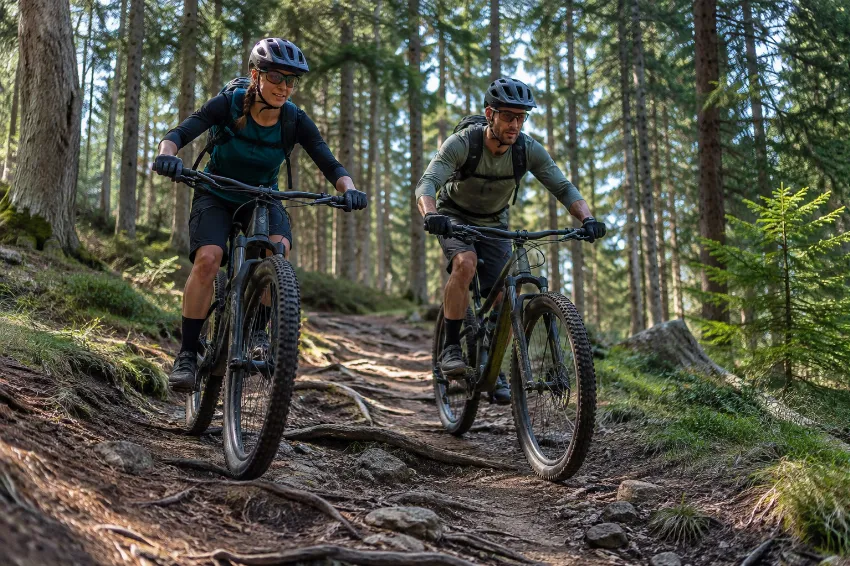
For a beginner, a hardtail is often the most practical starting point if you ride smoother forest paths, gravel tracks, and moderate singletrack. With no rear shock or frame pivot bearings to service, maintenance remains straightforward and mechanical costs stay low. You also learn clean line choice early, because your legs act as the rear suspension over roots and steps.
When looking at hardtail 29 mountain bikes, you will find models tailored to very different riders. The Scott Contrail 30 is an aluminium hardtail with a 100 mm SR Suntour XCE28 fork, a Shimano CUES 9-speed drivetrain, a dropper-post compatible frame, and trail-inspired geometry. It suits riders entering the sport who want a dependable, upgradeable frame for varied forest riding.
However, a beginner does not always have to start on a hardtail. If your local trails are immediately steep, rocky, and root-strewn, such as the rougher natural descents in Koroška, starting directly on a full-suspension bike reduces fatigue and keeps the rear tyre planted when you brake on uneven ground. Our workshop services bikes of all brands and is an official service partner for SRAM and Shimano components.
Cross-country bikes: built for speed and climbing
A cross country mountain bike is engineered for maximum pedalling efficiency, low weight, and brisk handling on climbs and undulating terrain. In competitive cycling, Cross-country Olympic (XCO) is raced on undulating circuits of 4 to 6 km, and a race lasts 1 h 20 min to 1 h 40 min depending on category. For longer endurance events, cross-country marathon is raced over 60 to 160 km.
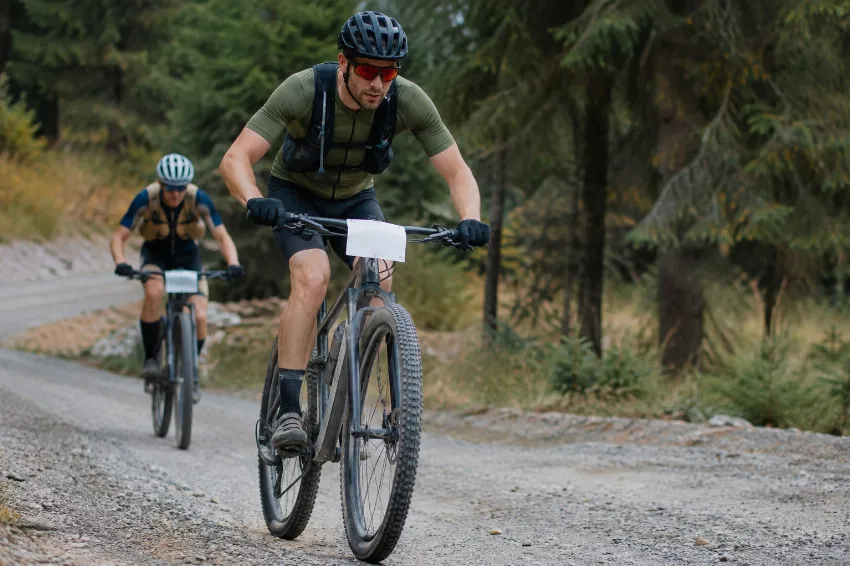
To convert every watt of rider effort into forward motion, our full-suspension XC / Race mountain bikes offer 80 to 110 mm of front and rear travel, most with the option to lock out the suspension. Flipping a handlebar lockout lever stiffens the fork and rear shock on smooth climbs or tarmac transitions so the suspension does not bob under pedalling load.
Cross-country bikes also come as hardtails. A clear example is the Scott Scale RC Comp, a carbon (HMF) hardtail built with a 110 mm Fox Rhythm fork, an electronic Shimano Deore Di2 12-speed drivetrain, and a dropper post. Including a dropper post on a race hardtail allows you to lower the saddle instantly for technical descents without sacrificing climbing posture.
The two hardtails from this article, for entry riders and for racing:
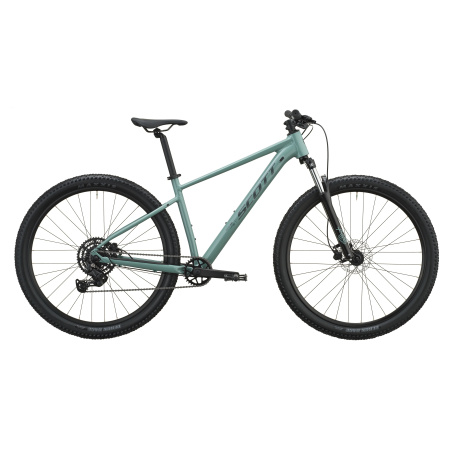 SCOTTMOUNTAIN BIKE SCOTT CONTRAIL 30 2027 Arctic green749,00 €
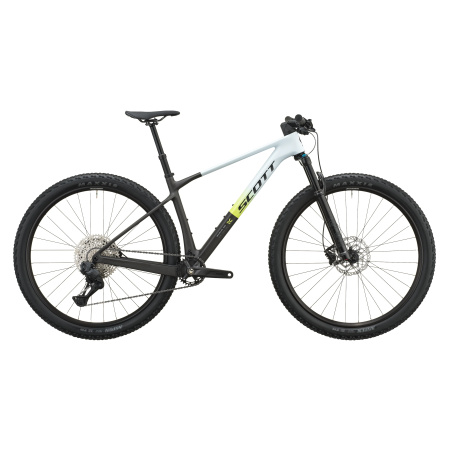 SCOTTMOUNTAIN BIKE SCOTT SCALE RC COMP 2027 Mirage blue/Carbon black2.799,00 €
What is the difference between XC and trail bikes? Cross-country bikes use shorter suspension travel (such as 80 to 110 mm on full-suspension XC models) and efficiency-focused geometry to maximise climbing and flat-ground speed, often featuring suspension lockouts. Trail bikes carry more travel and slacker geometry to prioritise traction, comfort, and control on technical descents over pure pedalling speed.
Trail bikes: the all-rounder
Trail bikes sit right in the middle of the mountain biking spectrum, balancing climbing composure with confident descending capability. If you want a single bicycle to pedal up long forest roads, flow across rolling singletrack, and handle rooty, technical sections on the way back down, the trail category is designed for you. In our shop catalogue, this middle ground is covered by our full-suspension all-mountain and trail bikes.
Rather than chasing race-clock seconds uphill or surviving extreme downhill tracks, a trail bike focuses on versatility and rider adjustment. A prime example is the Specialized Stumpjumper 15 Alloy, described by Specialized as the quintessential trail bike. Its specification illustrates how modern trail geometry and wheel sizing work together:
- Balanced suspension travel: 145 mm rear travel paired with a 150 mm fork (140 mm in size S1), absorbing mid-sized drops and square-edged roots while remaining responsive on climbs.
- Adjustable geometry: Six distinct geometry settings, allowing you to fine-tune the frame handling around its 64.5° head angle to match steeper or flatter local terrain.
- Size-specific wheel configuration: A 29-inch front wheel across the range, paired with a 27.5-inch rear wheel in sizes S1–S2.
- Real-world build weight: 16.57 kg in size S4 with its durable alloy frame construction.
When comparing a trail vs enduro bike, manufacturers do not all use a rigid, universal millimetre cutoff. As Trek notes in its buyer’s guide, enduro bikes are longer-travel trail bikes, and where trail ends and enduro begins depends on the region.
What is an enduro bike?
An enduro bike is a long-travel full-suspension mountain bike built for steep, rough descents while remaining capable of pedalling back up the mountain without a chairlift. In our category of full-suspension enduro bikes, models have around 150–180 mm of travel, a slacker head angle, and a steeper seat angle.
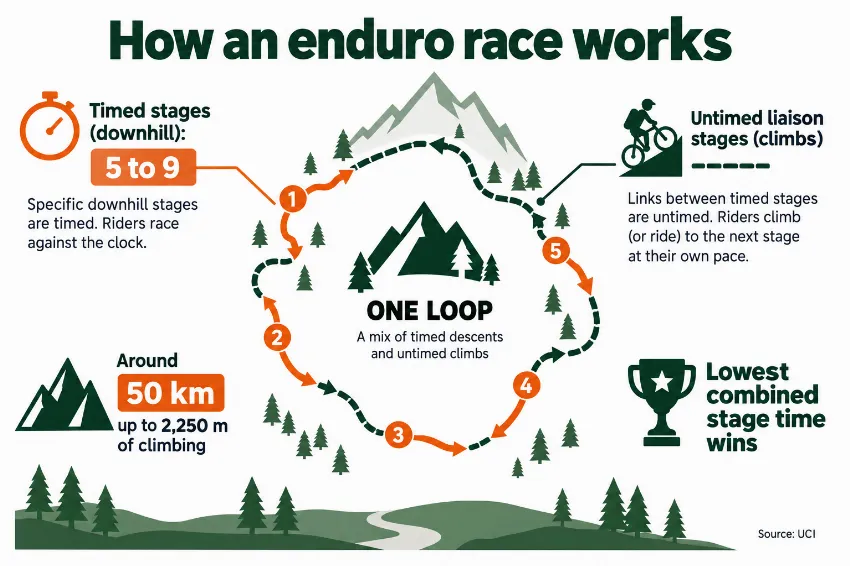
An enduro race is a mountain bike competition format defined by the UCI as multiple timed downhill stages linked together by untimed transfer climbs (liaison stages) that riders complete in sequence to form one large loop. The winner is the rider with the lowest combined stage time across all downhill sections, demanding both technical descending speed and the endurance to pedal between stages.
Understanding how an enduro race is run explains why these bicycles are built the way they are. According to the governing body, A typical UCI enduro course has 5 to 9 timed stages over around 50 km and up to 2,250 vertical metres. That is why enduro bikes combine a steeper seat angle for the climbs with a slacker head angle for the descents.
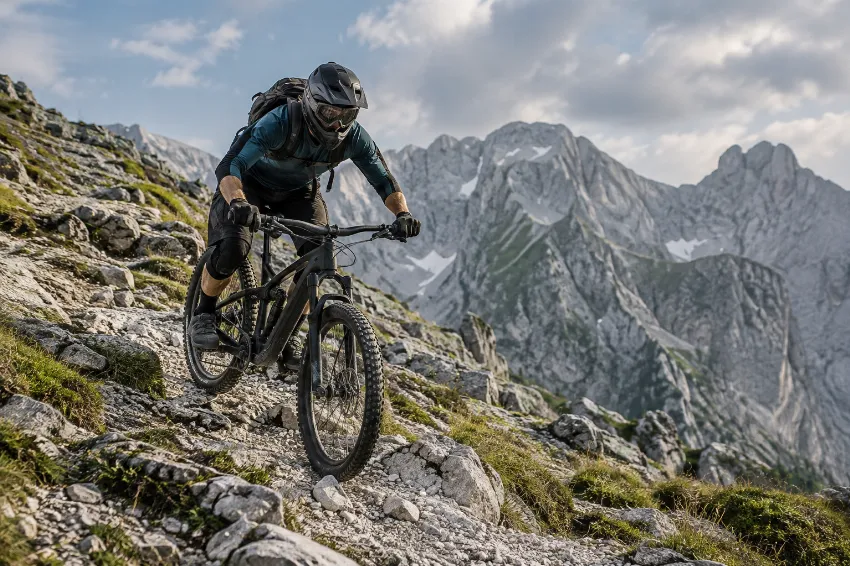
A benchmark model for this discipline is the Scott Ransom 20, engineered by Scott for maximum downhill performance. It combines a carbon (HMF) front triangle with an aluminium rear, Marzocchi suspension with 170 mm travel front and rear, and a SRAM Eagle 70 Transmission 12-speed drivetrain. That 170 mm of travel soaks up high-speed rock gardens and heavy landings, yet the 12-speed transmission provides the gear range needed for long Alpine transfer climbs.
The trail and enduro bikes from this article:
 SPECIALIZEDMOUNTAIN BIKE SPECIALIZED STUMPJUMPER 15 ALLOY 29 2025 Satin Cast Blue / Dove Grey
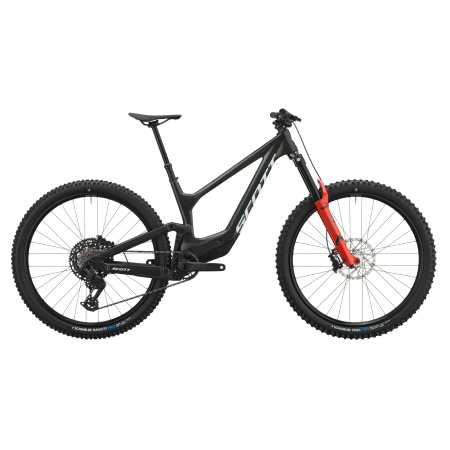 SCOTTSCOTT RANSOM 20 2027 mountain bike Carbon black4.339,00 €
Downhill bikes and electric mountain bikes
Downhill (DH) bikes sit at the extreme gravity end of the sport. The UCI describes downhill as a race against the clock in which the rider negotiates a succession of fast and technical passages. Downhill bikes are built for descending, not for pedalling uphill. Unless you ride exclusively at lift-accessed bike parks or race dedicated downhill tracks, an enduro or trail bike is a far more practical choice.
If you want to ride more descents in a single outing without relying on a chairlift, electric mountain bikes (e-MTBs) apply pedal-assist motors to hardtail, trail, and enduro platforms. You can explore our dedicated category of electric mountain bikes to see how motor assistance pairs with different suspension travels; our workshop also services Bosch and Shimano e-bike drive systems.
Choosing the right mountain bike for your terrain
Selecting among the main types of mountain bikes is ultimately an honest assessment of your local trails and riding goals. Choose a hardtail or short-travel cross-country bike if you value low weight, fast climbing, and simplicity on smoother forest tracks. Step up to a mid-travel trail bike if you want one versatile machine for varied singletrack, roots, and all-day mountain loops. Reserve long-travel enduro and downhill rigs for steep, rough gravity trails where high-speed descending stability outweighs pedalling lightness.
Browse mountain bikes in the Enduro shop or contact the shop in Ravne na Koroškem; we ship within Slovenia and to other EU countries.
Frequently asked questions
How much suspension travel do I need?
Match your travel to the roughest trails you ride regularly rather than buying the maximum available. Full-suspension XC bikes with 80 to 110 mm of travel (or 100 to 110 mm hardtails) suit smooth forest tracks and climbs, mid-travel trail bikes (such as 145/150 mm) handle varied singletrack with roots and rocks, and enduro bikes with around 150 to 180 mm are built for steep, technical descents.
Is a hardtail good for beginners?
Yes, a hardtail is an ideal choice for beginners riding smoother trails, forest roads, and moderate singletrack because it is lightweight and easier to maintain than a full-suspension bike. Models like the Scott Contrail 30 provide a 100 mm fork and trail-inspired geometry that help new riders build core bike-handling skills without complex rear-suspension upkeep.
Can I race enduro on a trail bike?
Yes, you can enter an enduro race on a capable trail bike, especially on courses with smoother forest stages and heavy pedalling sections. Because the boundary where trail ends and enduro begins depends on the region, a mid-travel trail bike like the Specialized Stumpjumper 15 Alloy (145 mm rear / 150 mm front travel) can be used for timed stages, though a dedicated 170 mm enduro bike offers more margin for error on the roughest, steepest tracks.
What is the difference between an enduro bike and a downhill bike?
An enduro bike is designed to be pedalled uphill on untimed liaison stages between timed descents, featuring around 150 to 180 mm of travel, a steeper seat angle, and a wide-range 12-speed drivetrain. A downhill bike is built purely for racing down fast, technical passages against the clock, not for pedalling uphill.
