
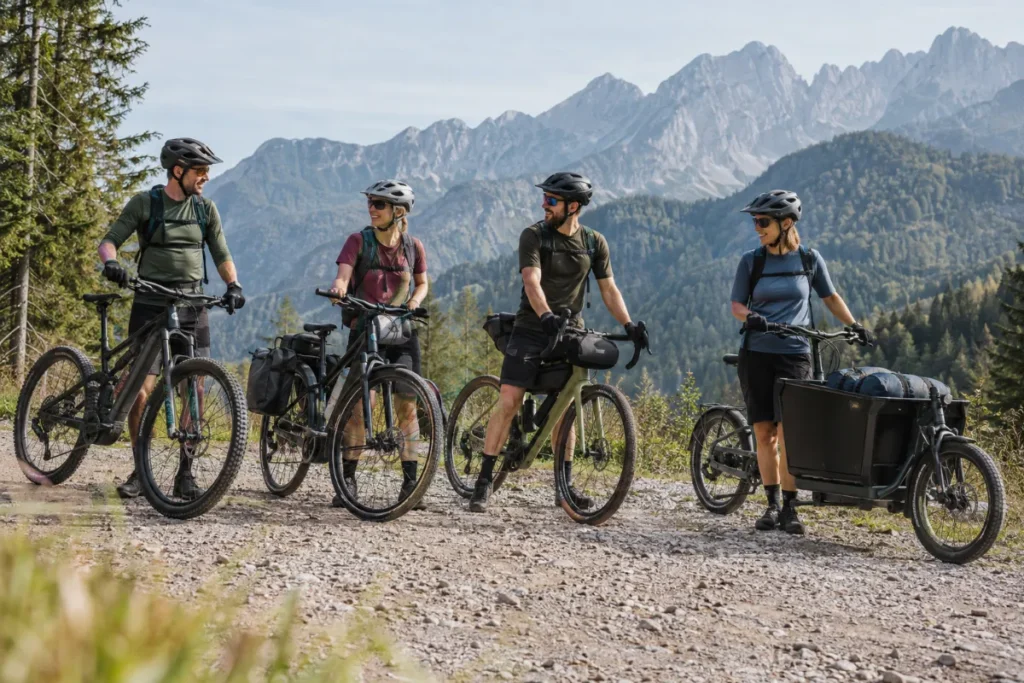
Choosing between the different types of electric bikes in Europe starts with two separate questions: how the European Union classifies the motor assistance by law, and what frame geometry, suspension travel and equipment match the terrain you ride. Under European rules, a standard pedal-assisted bicycle (pedelec) with a motor of up to 250 W that cuts out at 25 km/h is legally treated as an ordinary bicycle, whereas faster models are classified as motor vehicles that require type approval.
Once the legal category is clear, the decision comes down to riding purpose. Off-road trails call for a hardtail or full-suspension e-MTB, daily commuting and multi-day touring suit a fully equipped trekking bike, mixed tarmac and gravel roads favour a lighter e-gravel frame, and family transport requires a high-load cargo build. You can browse all current electric bikes in our online catalogue to see how these categories differ in battery capacity, motor torque and factory equipment.
What are the main types of electric bikes in Europe?
In the European Union, electric bikes are divided legally into standard pedelecs (assisted up to 25 km/h and 250 W, treated as regular bicycles) and speed pedelecs (classified as L1e-B mopeds). By riding style, the core categories are hardtail and full-suspension e-MTBs, trekking and city e-bikes, e-gravel bikes and electric cargo bikes.
Pedelec or speed pedelec: what EU rules say
A pedelec is a pedal-assisted bicycle whose auxiliary electric motor has a maximum continuous rated power of 250 W or less and cuts off assistance when the rider stops pedalling or reaches 25 km/h. Under European law, this distinction separates everyday bicycles from motor vehicles: Pedal cycles with a motor of 250 W or less whose assistance stops at 25 km/h are excluded from EU type approval (Source: Regulation (EU) No 168/2013, Article 2(2)(h)). As a result, a standard pedelec is treated as a bicycle rather than a motor vehicle.
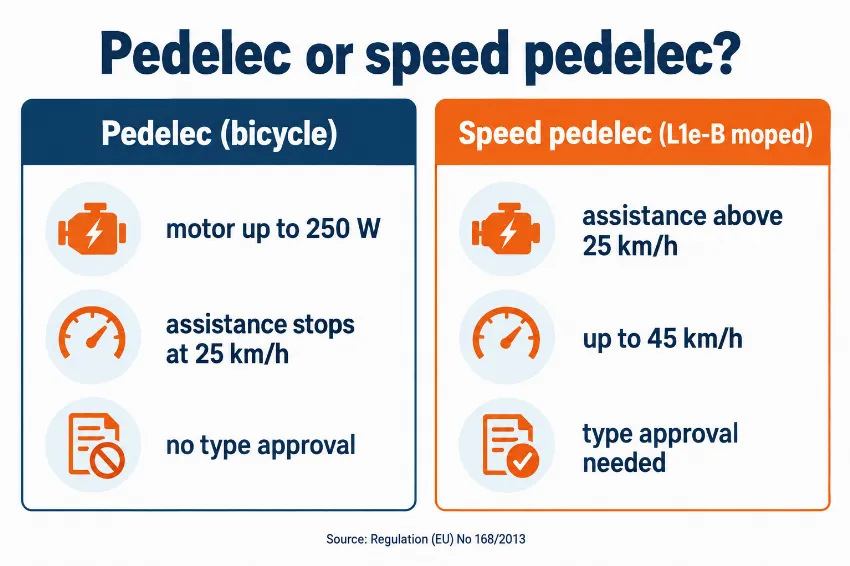
Most English-language guides online describe the United States “Class 1, Class 2 and Class 3” system. US e-bike classes do not apply in the European Union, which instead regulates two-wheel powered vehicles under Regulation (EU) No 168/2013. When an electric bike exceeds the standard pedelec limits, it falls into vehicle category L1e (light two-wheel powered vehicle), which Article 4(2)(a) divides into two sub-categories: the L1e-A powered cycle and the L1e-B two-wheel moped.
According to Annex I of the same regulation, L1e vehicles have a maximum design speed of 45 km/h (Source: Regulation (EU) No 168/2013) and a maximum continuous rated or net power of 4,000 W or less. Within this framework, the difference between a pedelec and a speed pedelec comes down to motor power, maximum assisted speed and legal classification:
- Standard pedelec (excluded from type approval): Pedal assistance only, maximum continuous rated power up to 250 W, motor assistance cuts off at 25 km/h or when you stop pedalling. Treated legally as a conventional bicycle.
- L1e-A powered cycle: Designed to pedal, with auxiliary propulsion that aids pedalling up to 25 km/h or less and continuous rated or net power of at most 1,000 W. Requires EU type approval under category L1e.
- L1e-B two-wheel moped (speed pedelec): Any other L1e vehicle that exceeds pedelec or L1e-A limits, such as pedal-assisted bikes supporting the rider up to 45 km/h. Speed pedelecs require type approval as mopeds.
Because traffic laws are set at national level, specific rules for speed pedelecs regarding compulsory helmets, insurance, number plates and driving licences vary by country, so you should always verify the regulations in your member state before buying an L1e-B model.
Electric mountain bikes: hardtail or full suspension?
Choosing between hardtail and full-suspension electric mountain bikes depends on how rough your trails are and whether you want the frame to accept commuting accessories. Both styles use high-torque mid-drive motors and large integrated batteries for steep off-road climbs, yet their rear triangle construction changes how the bike handles roots, rock gardens and everyday utility.
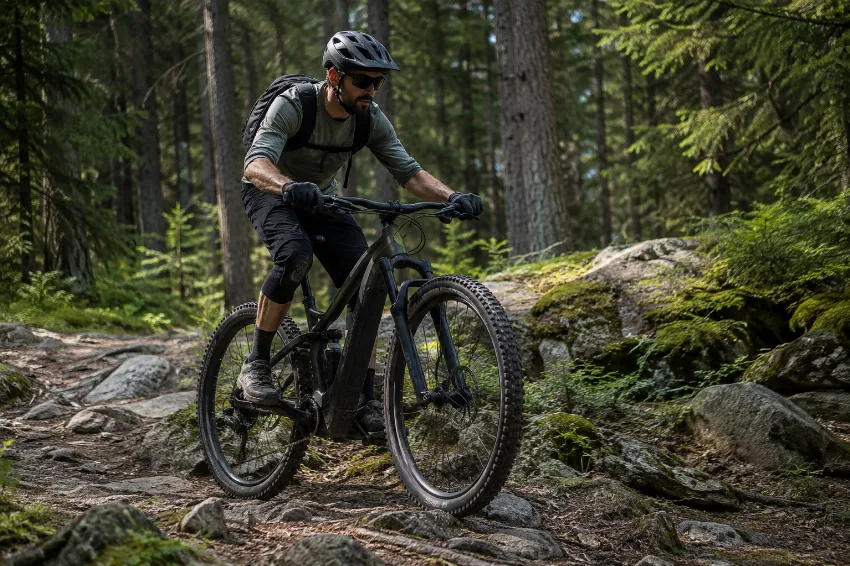
A hardtail electric bike has a suspension fork at the front and a rigid rear triangle. A clear example is the Cube Reaction Hybrid Pro 800, an aluminium hardtail e-MTB weighing 24.9 kg. Its specification shows how versatile a modern hardtail can be:
- Motor and battery: Bosch Performance Line CX motor delivering up to 120 Nm of torque, paired with a Bosch PowerTube 800 Wh battery that is PowerMore-ready for an optional 250 Wh range extender.
- Suspension and wheel sizing: RockShox Recon Silver RL Air fork with 120 mm travel; frame size S rolls on 27.5-inch wheels, while sizes M to XXL use 29-inch wheels.
- Everyday mounts: Integrated mounting points for a rear rack, mudguards and a kickstand, making it straightforward to convert for wet-weather commuting.
When trails become steeper and more technical, full-suspension electric bikes add a rear shock to absorb impacts, maintain rear-tyre traction on loose climbs and reduce rider fatigue over long descents. The Scott Patron 20 represents this category with 150 mm of suspension travel front and rear and 29-inch wheels. It shares the Bosch Performance Line CX motor (up to 120 Nm) and a removable 800 Wh battery, but houses its rear shock inside the frame and has an integrated rear light.
If your riding mixes forest tracks, gravel fire roads and weekday commutes where a rack or kickstand is useful, a 120 mm hardtail is the practical choice. If you ride root-heavy singletrack and alpine descents where rear-wheel grip is critical, a 150 mm full-suspension frame is worth the extra mechanical complexity.
The two electric mountain bikes from this section:
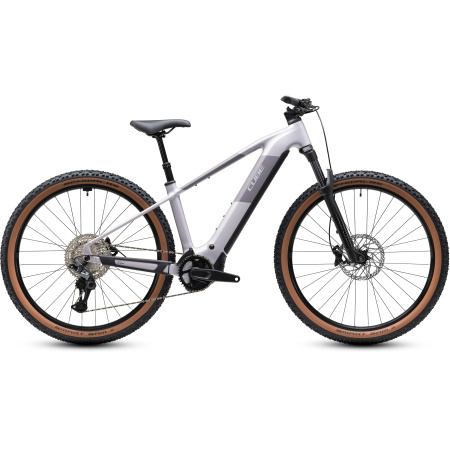 CUBEELECTRIC MOUNTAIN BIKE CUBE REACTION HYBRID PRO 800 2027 LILACBREEZE´N´PRIZM3.399,00 €
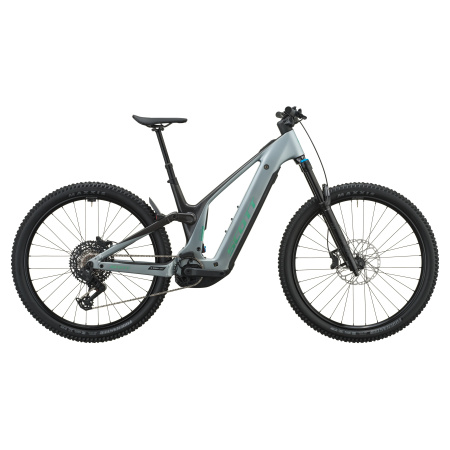 SCOTTELECTRIC MOUNTAIN BIKE SCOTT PATRON 20 2027 Pulse grey/Carbon black7.649,00 €
Trekking and city e-bikes for everyday riding
A fully equipped trekking e-bike is generally the best electric bike type for commuting and all-weather touring because it can come from the factory with lights, mudguards, a pannier rack and a kickstand. While riders sometimes adapt a hardtail e-MTB for weekday travel, purpose-built trekking electric bikes and electric city bikes put you in a more comfortable posture for traffic visibility and long hours in the saddle, without needing aftermarket parts.
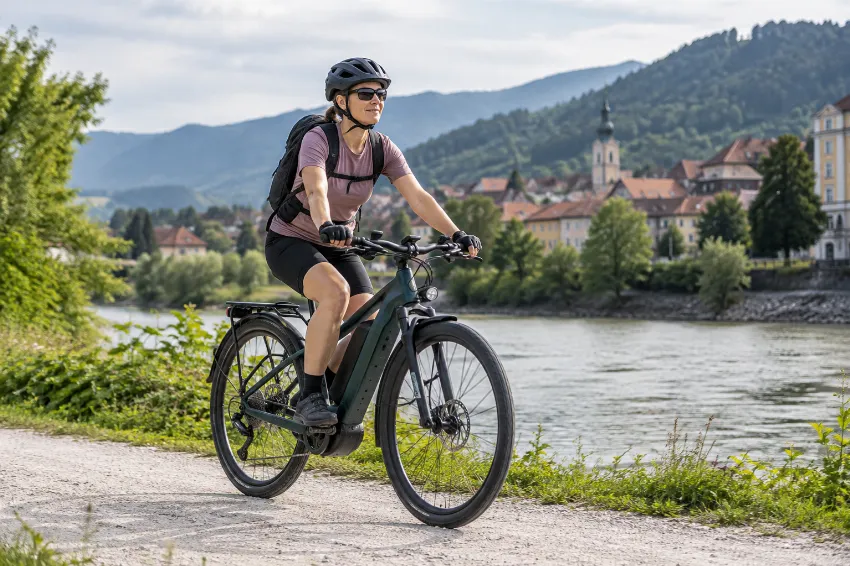
The KTM Macina Style 740 illustrates what a complete European trekking specification includes:
- Drive unit and energy storage: Bosch Performance CX motor with 85 Nm of torque and a Bosch PowerTUBE 750 Wh battery.
- Comfort components: A 63 mm suspension fork paired with a suspension seatpost and 28-inch wheels fitted with 50 mm tyres to smooth out broken tarmac and cobbles.
- Factory commuting kit: A 50 lux front light and a rear light, plus a carrier rack, mudguards and a kickstand, bringing the complete weight to about 27.5 kg.
Comparing the KTM Macina Style 740 with the two mountain bikes above also highlights an important technical detail when reading specification sheets: motor torque figures depend on the exact model configuration and year, so the Bosch Performance CX motor is specified at 85 Nm on the KTM Macina Style 740 and up to 120 Nm on the Cube Reaction Hybrid Pro 800 and Scott Patron 20. Always check the torque and battery capacity in watt-hours (Wh) listed for the individual bike rather than assuming a motor family has a single fixed output.
E-gravel and electric cargo bikes
Beyond mountain and trekking frames, two more electric bike types address opposite ends of the riding spectrum: lightweight drop-bar bikes for fast mixed-surface riding, and heavy-duty utility frames built to replace a car on family errands.
For cyclists who want the speed and hand positions of road electric bikes with the tyre clearance to turn onto unpaved tracks, an e-gravel bike swaps heavy suspension forks for a rigid carbon front end and a compact battery system. The Orbea Denna H30 uses a full-carbon fork, 700 x 45 mm gravel tyres, a Shimano GRX 12-speed drivetrain and hydraulic disc brakes. Its Shimano EP600 motor delivers up to 85 Nm of torque, drawing power from an integrated 420 Wh battery that can be paired with an optional 210 Wh range extender for a combined capacity of 630 Wh.
An e-cargo bike is a reinforced electric bicycle engineered to carry heavy loads, groceries or passengers, often children, within a high permissible total weight. The KTM Macina Multi is an electric cargo and family bike built around 24-inch wheels and a permissible total weight of 200 kg (covering the bike, rider and payload). It runs a Bosch Performance motor with 65 Nm of torque and a 500 Wh battery that can be extended to a dual 2 x 500 Wh setup (1,000 Wh total), with frame geometry that leaves room for child seats at both the front and rear.
Which type of electric bike is right for you?
To match the different types of e-bikes to your routes, compare the surfaces you ride most often against the suspension travel, wheel size and factory equipment of representative models in each category.
| Type of electric bike | Primary terrain | Typical features (example model) | Who it is for |
|---|---|---|---|
| Hardtail e-MTB | Forest tracks, gravel paths, light trails and mixed commuting | Cube Reaction Hybrid Pro 800: Bosch CX (max. 120 Nm), 800 Wh battery (PowerMore-ready for up to 250 Wh extra), 120 mm air fork, 29″ wheels (27.5″ on S), mounts for rack, mudguards and kickstand, 24.9 kg | Riders who want off-road capability with the option to fit everyday commuting accessories |
| Full-suspension e-MTB | Steep singletrack, rocky trails, roots and alpine descents | Scott Patron 20: Bosch CX (up to 120 Nm), removable 800 Wh battery, 150 mm travel front and rear, frame-hidden rear shock, 29″ wheels, integrated rear light | Trail and all-mountain riders prioritising maximum traction, comfort and control on rough terrain |
| Trekking e-bike | Paved roads, cycle paths, cobbles and light gravel touring tracks | KTM Macina Style 740: Bosch CX (85 Nm), 750 Wh battery, 63 mm fork, suspension seatpost, 50 lux front light, rear light, rack, mudguards, kickstand, 28″ wheels with 50 mm tyres, about 27.5 kg | Daily commuters and touring cyclists who want a complete, road-ready setup straight from the box |
| E-gravel bike | Tarmac, gravel roads, country lanes and rolling back roads | Orbea Denna H30: Shimano EP600 (up to 85 Nm), 420 Wh integrated battery + optional 210 Wh range extender (630 Wh total), full-carbon fork, 700 x 45 mm tyres, Shimano GRX 12-speed, hydraulic disc brakes | Road and gravel riders looking for drop-bar efficiency and lighter handling with motor support on climbs |
| Electric cargo & family bike | Urban streets, school runs and paved utility routes | KTM Macina Multi: Bosch Performance (65 Nm), 500 Wh battery expandable to 2 x 500 Wh (1,000 Wh), 24″ wheels, 200 kg permissible total weight, space for front and rear child seats | Families and urban riders transporting children, heavy shopping or cargo instead of driving a car |
When narrowing down your shortlist, avoid choosing an e-MTB solely for its high torque figure if most of your riding is on wet asphalt: fitting mudguards, lights and a pannier rack later costs extra time and money compared with buying a fully equipped trekking bike. Conversely, if you plan to ride natural mountain trails, a 63 mm trekking fork is not designed for that terrain, making a 120 mm hardtail or 150 mm full-suspension model the safer long-term investment.
Summary: matching the e-bike category to your routes
Understanding the different types of electric bikes comes down to pairing EU legal categories with the right frame design. For hassle-free riding on European cycle infrastructure without moped type approval, stick to a standard pedelec rated up to 250 W and 25 km/h. From there, choose a 120 mm hardtail or 150 mm full-suspension e-MTB for off-road trails, a fully equipped 28-inch trekking bike for daily commuting, a carbon-fork e-gravel bike for fast mixed-surface rides, or a 24-inch cargo bike with a 200 kg permissible total weight for family transport.
Trekking, e-gravel and cargo e-bikes from this article:
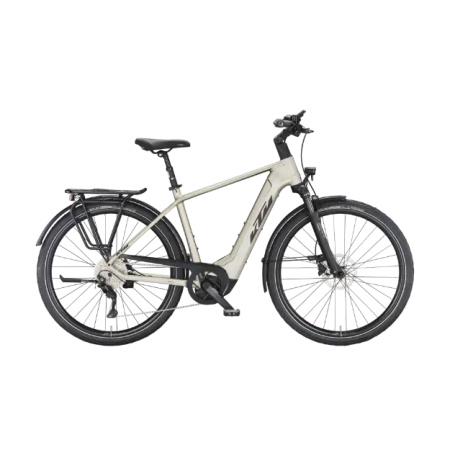 KTMKTM MACINA STYLE 740 ELECTRIC CITY BIKE CHAMPAGNE MATT
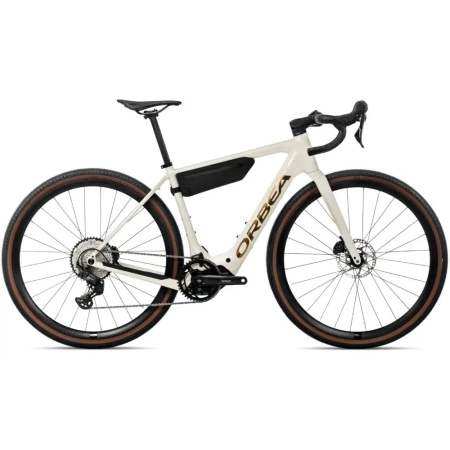 ORBEAELECTRIC GRAVEL BIKE ORBEA DENNA H30 2027 Ivory White4.199,00 €
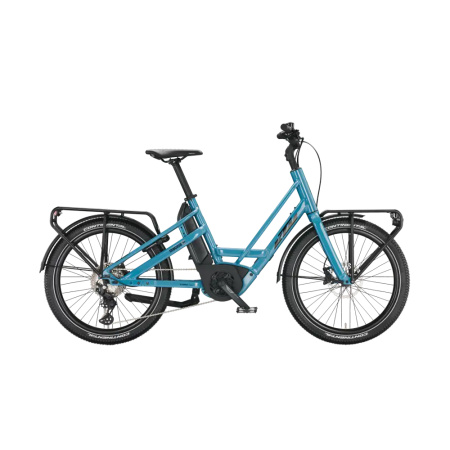 KTMELECTRIC CARGO BIKE KTM MACINA MULTI UNI 24 Black/orange
At Enduro in Ravne na Koroškem, Slovenia, our bike shop and workshop have helped riders choose and maintain bicycles since 2001. Our mechanics service bikes of all brands, and we are an official service partner for SRAM and Shimano components, as well as servicing Bosch and Shimano electric drive systems. Compare electric bikes in the Enduro shop or contact the shop in Ravne na Koroškem; we ship within Slovenia and to other EU countries.
Frequently asked questions
Do US e-bike classes apply in the European Union?
No, the US Class 1, 2 and 3 system has no legal standing in Europe. In the EU, Regulation (EU) No 168/2013 treats pedal-assisted bikes up to 250 W and 25 km/h as regular bicycles, while more powerful or faster models fall into vehicle category L1e (L1e-A powered cycles or L1e-B mopeds) and require type approval.
Do I need type approval or insurance for a standard 25 km/h pedelec?
Under EU Regulation 168/2013, a pedelec with a maximum continuous rated power of 250 W whose assistance cuts out when you stop pedalling or reach 25 km/h is excluded from EU vehicle type approval. Speed pedelecs that assist up to 45 km/h are classified as L1e-B mopeds and require type approval; check your national rules for specific helmet, insurance and registration requirements.
Should I choose a hardtail or full-suspension e-MTB?
Choose a hardtail e-MTB like the Cube Reaction Hybrid Pro 800 (120 mm front travel) if you ride forest tracks, gravel roads and want factory mounts for a rack, mudguards and a kickstand. Choose a full-suspension e-MTB like the Scott Patron 20 (150 mm front and rear travel) if you ride steep, rocky or root-filled singletrack where rear-wheel traction and impact absorption are essential.
Is a trekking e-bike or an e-MTB better for commuting?
A fully equipped trekking e-bike such as the KTM Macina Style 740 is better for most commuters because it comes fitted with a 50 lux front light, rear light, mudguards, a pannier rack, a kickstand and 50 mm road-friendly tyres. An e-MTB is only preferable for commuting if your daily route includes rough unpaved trails, in which case a hardtail with rack and mudguard mounts is the most practical compromise.
