

If you are asking yourself what is a gravel bike, the clearest answer lies in its mixed-surface design: it is a drop-bar bicycle built to link paved roads with unpaved tracks in a single ride. Instead of forcing you to turn back where the tarmac ends, a gravel bike uses wider tyres, disc brakes, and a stable frame geometry to handle broken asphalt, gravel roads in Koroška, and forest roads on Pohorje with equal composure.
For riders across Europe, this versatility solves a common dilemma. You no longer need to choose between the brisk pace of a road bicycle and the off-road capability of a trekking or mountain machine. Whether you plan to ride long-distance cycle paths along the Drava and Mur or commute across variable city surfaces, understanding how gravel geometry, tyre clearance, and mounting points compare to traditional road, cyclocross, and European trekking models will help you select the exact machine for your terrain.
Gravel bike: the short answer
A gravel bike is a versatile drop-bar bicycle designed for riding across both paved roads and unpaved surfaces such as gravel tracks, forest paths, and cobbles. It combines the efficient riding position of a road bike with wider tyre clearance, hydraulic disc brakes, and frame mounting points for bags and mudguards.
What is a gravel bike?
A gravel bike is an all-road, drop-bar bicycle engineered for mixed-terrain riding, long distances, and everyday versatility. According to the UCI, gravel combines elements of road and mountain biking on unsealed roads, ridden mainly on gravel, forest tracks, farm roads, and cobbles. Compared with a road racing bike, a gravel frame has clearance for much wider tyres.
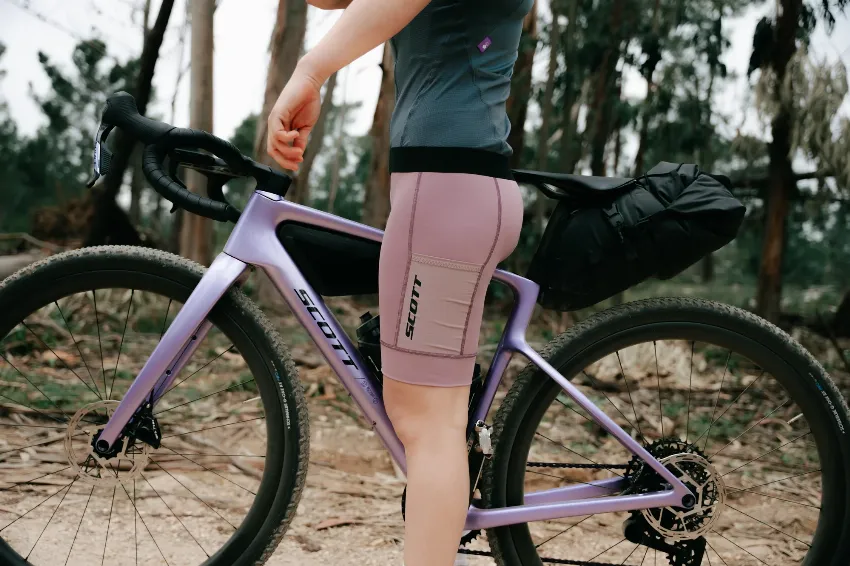
Manufacturers design these frames to cover multiple riding styles without requiring complex suspension systems. For example, Cube describes its Nuroad gravel bikes as a drop-bar set-up for adventure, commutes, bikepacking and long distances (Source: CUBE). Models such as the Scott Speedster Gravel 30 and the Cube Nuroad Race pair aluminium frames with carbon forks.
Gravel also has an official competitive structure. The UCI Gravel World Series is a mass-participation series; its first calendar in 2022 had 12 events, and the fastest 25% of men and women in each age group qualify for the UCI Gravel World Championships, which were first held in Veneto, Italy, in October 2022. If you prefer motor assistance on steep unpaved climbs, electric road and e-gravel bikes apply this same mixed-surface geometry to a pedal-assist platform.
Key features: tyres, gearing, brakes and mounts
Tyre clearance is the physical space between a bicycle fork, seatstays, and chainstays that determines the maximum width of a tyre you can safely install on the wheel. In gravel riding, frame clearance dictates both your off-road grip on loose stones and whether you have enough room left over to fit full-length mudguards for wet weather.
What tyre width does a gravel bike use? On the two gravel bikes in this article the tyres are 45 mm wide on 700C wheels: the Scott Speedster Gravel 30 comes equipped with Schwalbe G-One RX 700 x 45C tyres, while the Cube Nuroad Race fits 45 mm Schwalbe G-One R tyres and offers frame clearance for tyres up to 50 mm, or 45 mm when mudguards are installed.
Beyond rubber volume, several mechanical components separate gravel builds from standard road bicycles:
- Flared drop bars: Unlike narrow road handlebars, models like the Cube Nuroad Race use a flared drop bar where the lower drops angle outwards.
- Dedicated drivetrains and brakes: Gravel bikes come with 1x (single chainring) or 2x (double chainring) gearing and disc brakes. The Cube Nuroad Race uses a Shimano GRX 2×12 drivetrain at a total bike weight of 10.5 kg, whereas the Scott Speedster Gravel 30 relies on hydraulic disc brakes for consistent stopping power in mud and rain. As an official service partner for SRAM and Shimano components, our workshop in Ravne na Koroškem services bikes of all brands and maintains these gravel-specific drivetrains and braking systems.
- Frame and fork mounting points: To support commuting and multi-day touring, frames integrate threaded eyelets beyond standard bottle cages. The Scott Speedster Gravel 30 features a carbon fork with integrated mounting points, while the Cube Nuroad Race includes mudguard and rack options alongside lowrider mounts on the fork.
The two gravel bikes from this section:
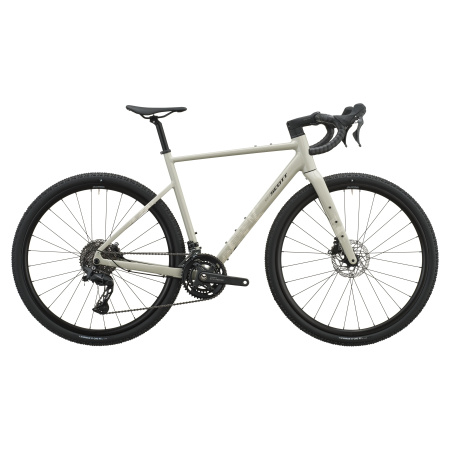 SCOTTGRAVEL BIKE SCOTT SPEEDSTER GRAVEL 30 2027 Agate grey1.659,00 €
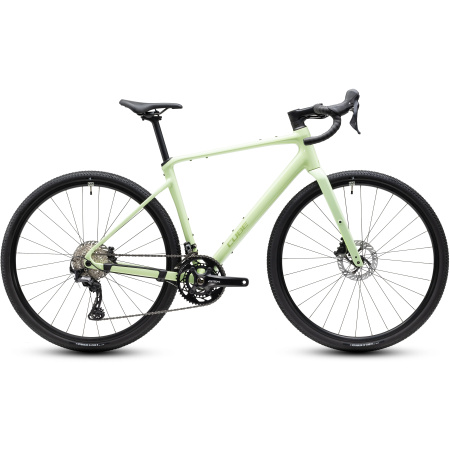 CUBEGRAVEL BIKE CUBE NUROAD RACE 2027 LINDGREEN´N´MATCHA1.599,00 €
Gravel bike vs road, cyclocross and trekking bike
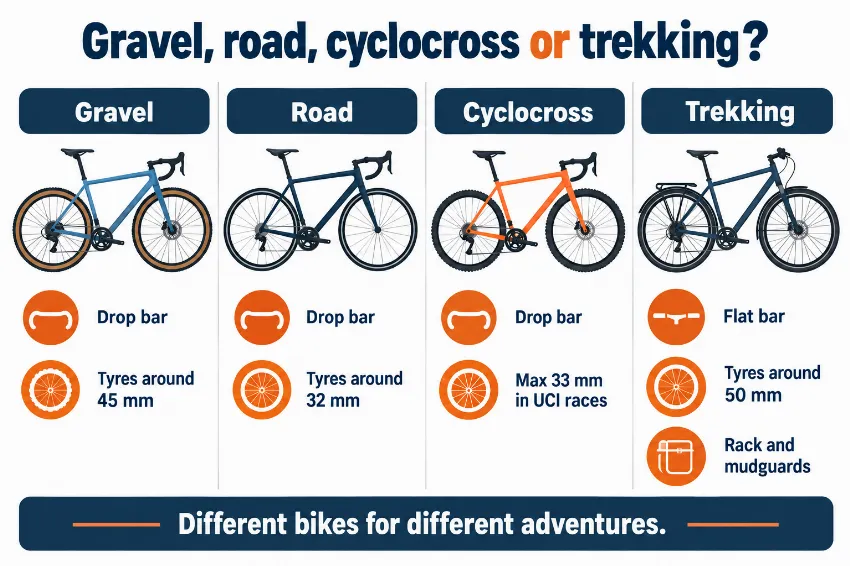
When comparing a gravel bike vs road bike, a cyclocross machine, or a European trekking bicycle, the primary differences come down to tyre volume, handlebar geometry, and luggage compatibility. While many riders group these categories together, each platform is built around specific terrain constraints.
Looking at a gravel bike vs road bike, you will immediately notice the tyre width and riding posture. A road model such as the Scott Speedster 20 uses an aluminium frame, carbon fork, compact drop bar, and a Shimano 2×10 drivetrain, rolling on narrower Schwalbe Lugano 700 x 32C tyres at a weight of 10.9 kg. Those 32 mm tyres roll efficiently on tarmac, and the frame is even mudguard-ready, but it lacks the 45 mm to 50 mm tyre volume and flared bar control required for loose gravel tracks.
When evaluating a gravel bike vs cyclocross bike, the distinction is governed by racing regulations and frame utility. Cyclocross bikes are built for short, intense off-road circuit races rather than all-day comfort. Under official competition standards, in cyclo-cross the tyre width may not exceed 33 mm and spikes or studs are not allowed (Source: UCI rule 1.3.018 via Cycling BC). A cyclocross bike is therefore built around much narrower race tyres than a 45 mm gravel setup.
In the gravel vs trekking bike comparison (often searched as gravel bike vs hybrid), handlebar shape and drivetrain simplicity take centre stage. A European trekking bike like the Scott Sub Cross 40 features an aluminium frame and rigid fork, a flat bar with a 12 mm rise, a 1×8 drivetrain, and wide 700 x 50 tyres, weighing 12 kg. It is compatible with mudguards, a rack, and a kickstand (though mudguards, rack, and lights are not included as standard). Compared to a drop-bar gravel model, the trekking bicycle places you in a more upright posture with wider 50 mm tyres as standard, trading aerodynamic hand positions for upright urban visibility and kickstand compatibility.
| Feature | Gravel Bike (Cube Nuroad Race / Scott Speedster Gravel 30) | Road Bike (Scott Speedster 20) | Cyclocross Bike (UCI Standard) | Trekking Bike (Scott Sub Cross 40) |
|---|---|---|---|---|
| Fitted Tyre Width | 45 mm (700 x 45C); clearance up to 50 mm (45 mm with mudguards on Cube) | 32 mm (700 x 32C) | Maximum 33 mm in UCI races (no spikes or studs) | 50 mm (700 x 50) |
| Handlebar Type | Drop bar / Flared drop bar | Compact drop bar | Drop bar | Flat bar (with 12 mm rise) |
| Gearing Setup | 1x or 2x (e.g., Shimano GRX 2×12 on Cube Nuroad Race) | Shimano 2×10 drivetrain | Varies by build | 1×8 drivetrain |
| Mounts & Accessories | Mudguard, rack, and fork lowrider/integrated mounts | Mudguard-ready | Varies by build | Mudguard, rack, and kickstand compatible |
| Weight (Example) | 10.5 kg (Cube Nuroad Race) | 10.9 kg | Varies by build | 12 kg |
| Best For | Mixed tarmac, gravel roads, bikepacking, long distances, commutes | Paved roads, fast tarmac rides | Sanctioned cyclo-cross racing | Upright leisure riding, rough paths, utility commuting |
The downsides: who should buy something else
Despite its broad capability, a gravel bicycle is always a compromise between two worlds, and there are clear scenarios where another category of bicycles will serve you better. Understanding these trade-offs before purchasing prevents the frustration of riding the wrong geometry for your primary terrain.
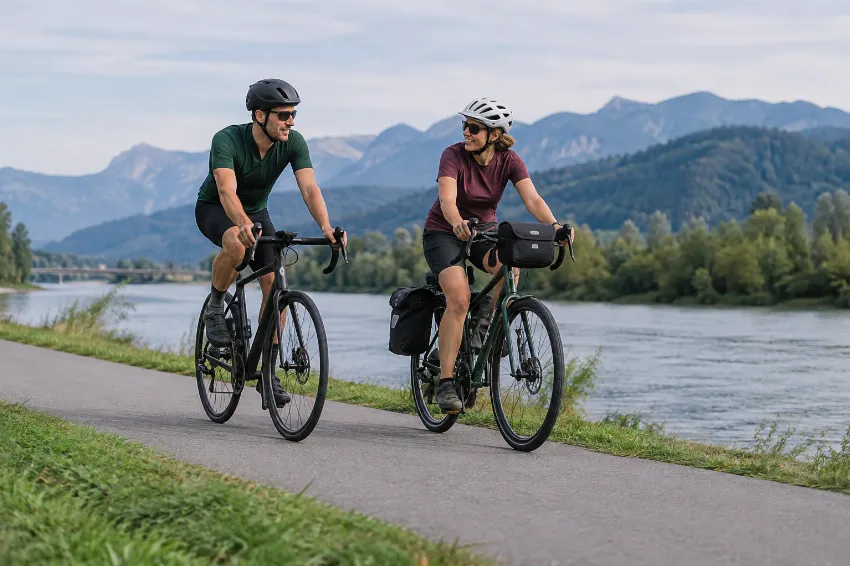
If you ride exclusively on smooth tarmac and prioritise group rides or pure speed, road bikes suit speed riders better. While a gravel frame can certainly be ridden on asphalt, its 45 mm tyres and flared handlebars are not built for speed in the way of a dedicated road machine equipped with 32 mm slick tyres and a compact drop bar.
Conversely, when choosing between a gravel or trekking bike for commuting with heavy daily luggage, a trekking bike comes closer to a ready-equipped urban workhorse. Although gravel models like the Cube Nuroad Race accept mudguards and rear racks, trekking platforms such as the Scott Sub Cross 40 offer a heads-up flat-bar position for dense city traffic, native 50 mm tyres, and compatibility with a kickstand. Finally, if your off-road routes go beyond forest tracks into steep, rocky singletrack, a rigid gravel fork is not designed for that terrain, making a hardtail or full-suspension mountain bike the logical choice.
Summary: is a gravel bike right for you?
Now that you know what is a gravel bike and how its components function in practice, the final decision comes down to the surfaces you ride every week. If your routes combine paved lanes, agricultural tracks, and forest roads, a drop-bar gravel setup with 45 mm tyres and hydraulic disc brakes gives you the freedom to link those sectors without changing bicycles. If you stay strictly on smooth asphalt or need an upright flat-bar commuter with a kickstand, a road or trekking model remains the more specialised tool.
The road and trekking bikes used for comparison:
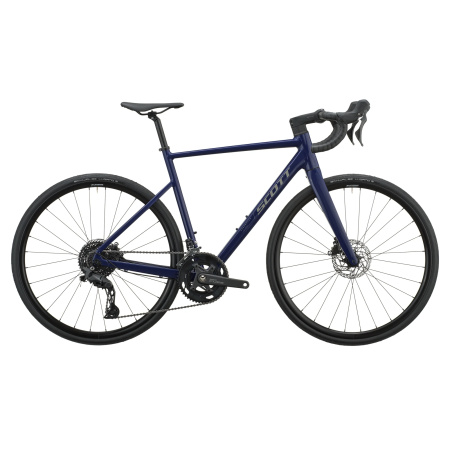 SCOTTROAD BIKE SCOTT SPEEDSTER 20 2027 tide blue1.559,00 €
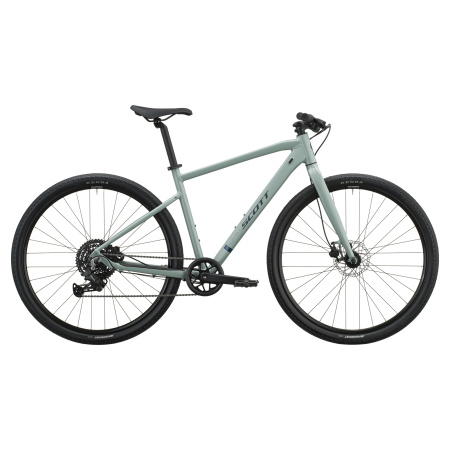 SCOTTTREKKING BIKE SUB CROSS 40 2027 Grey629,00 €
Frequently asked questions
Can I ride a gravel bike on the road?
Yes, a gravel bike rolls efficiently on paved roads thanks to its 700C wheels, drop handlebars, and road-inspired frame geometry. While 45 mm gravel tyres do not feel as fast on smooth tarmac as 32 mm road tyres, they provide extra comfort over potholes and broken city asphalt.
Can I fit mudguards and a rack to a gravel bike?
In most cases, yes, provided you check the specific frame specifications. For example, the Cube Nuroad Race features mounting points for mudguards, a rear rack, and fork lowriders (allowing up to 45 mm tyres with mudguards fitted), while the Scott Speedster Gravel 30 includes integrated mounting points on its carbon fork.
Should I choose a gravel or trekking bike for commuting?
Choose a gravel bike for commuting if your route is longer, mixes road and gravel paths, and you prefer the speed of drop handlebars. Choose a trekking bike like the Scott Sub Cross 40 if you prefer an upright flat-bar riding position, 50 mm tyres, and compatibility with a kickstand alongside mudguards and a rack.
Can a gravel bike be your only bike?
A gravel bike can easily serve as your only bike if you want one machine for weekend road rides, forest track exploration, bikepacking, and daily commuting. By adjusting tyre choices or adding mudguards and racks, it covers a wide range of terrain, falling short mainly in pure tarmac racing or technical mountain biking.
Browse gravel bikes in the Enduro shop or contact the shop in Ravne na Koroškem; we ship within Slovenia and to other EU countries.
